After writing several posts, I have realized that I did not mention that where the name of my blog comes from. Unfortunately, there is no special story behind and I picked this word just because I like it. But, I should at least tell you what's the meaning of the word.
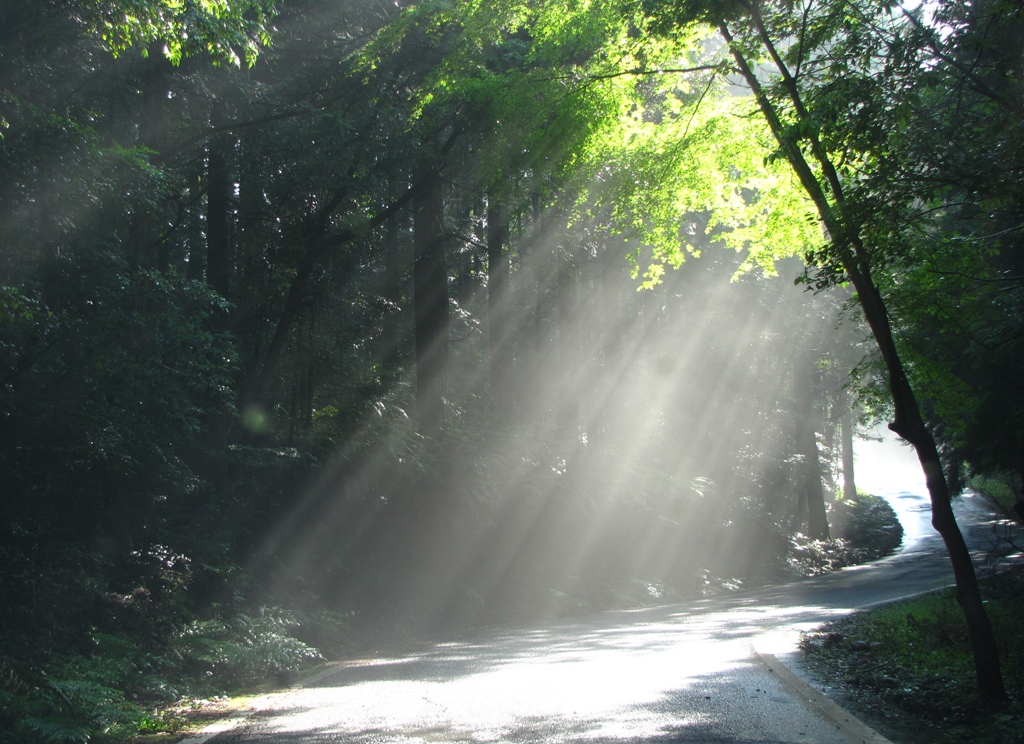
Although there is no direct translation for Komorebi(木漏れ日), it basically means that sunlight filters through trees.
Since I talked about Komorebi, I want to introduce some Japanese words which Japanese people use in everyday life, but there is no English equivalent.
- いただきます&ごちそうさま (Itadakimasu& Gochisousama)
Before Japanese people start eating, we say Itadakimasu to show appreciations for food and people who cooked the meal. Similarly, after we finish eating, we say Gochisosama to thank again. This is also a manner, so if you do not say this when you are eating with someone, it is considered to be rude. - お疲れ様 (Otsukaresama)
Otsukaresama is often translated as "Good Job" or "Well done", but it has a more extended meaning and we use on many occasions. For example, when people finish their work or school, they say Otsukaresama to each other. We also use this word as a greeting when people leave. - もったいない(Mottainai)
Japanese people use this word when someone is wasting things. The idea of Mottainai comes from beliefs that everything has a soul and we should respect them. Growing up in Japan, I was taught not to waste things and utilize them longer until they cannot be used.
I wanted to share those words not only because we use it often, but I think those words are strongly tied with Japanese culture. If any of you is interesting in any culture, it would be interesting to learn its language and how it reflects the culture.
OMG!!!! These Japanese words are amazing! First of all, I like how you explain the meaning of your blog title, because I can feel a special inner power of peace, and I do think it's kind of Japanese traditional culture.
ReplyDeleteAlso, I will take notes of Itadakimasu& Gochisousama, they are really helpful!! As I told you before, I'm going to spend this winter in Sapporo, Otaru, Noboribetsu, and Hakodate. I'm pretty sure I will use these two words a lot during my vacation! Thanks so much!
- Xiaoxin
I am Japanese American and I enjoyed reading this blog post because it reminded me of home. My family and I do not speak fluent Japanese but we know and say a few terms including "itadakimasu" before we eat. My family hates to have good food go to waste and says "mottanai" when regarding food that is still left over on our plate.
ReplyDeleteI liked this post a lot. It was super easy to read and the detail was very interesting. I sometimes miss nature a great deal as well-- it is difficult to constantly be in an urban environment. You should check out the club "peaks and professors!-Daniel
ReplyDeleteWhen I was clicking on your blog, I was wondering what Komorebi meant. I was actually about to Google it until I read the first few sentences of your post! As someone who is also bilingual, I feel like there are a lot of words that don't carry the same meaning when translated into different languages. Cool post!
ReplyDeleteあんな! もう一度誕生日おめでとう! けど今大切な秘密を教える。誰にも言わないでね。
ReplyDelete。
。
。
タピオカを飲みたい 笑
I love how you spoke about japanese words that dont have an english meaning because i face that struggle all the time when I try to explain farsi words in english to my friends. And Otsukaresama.
ReplyDelete